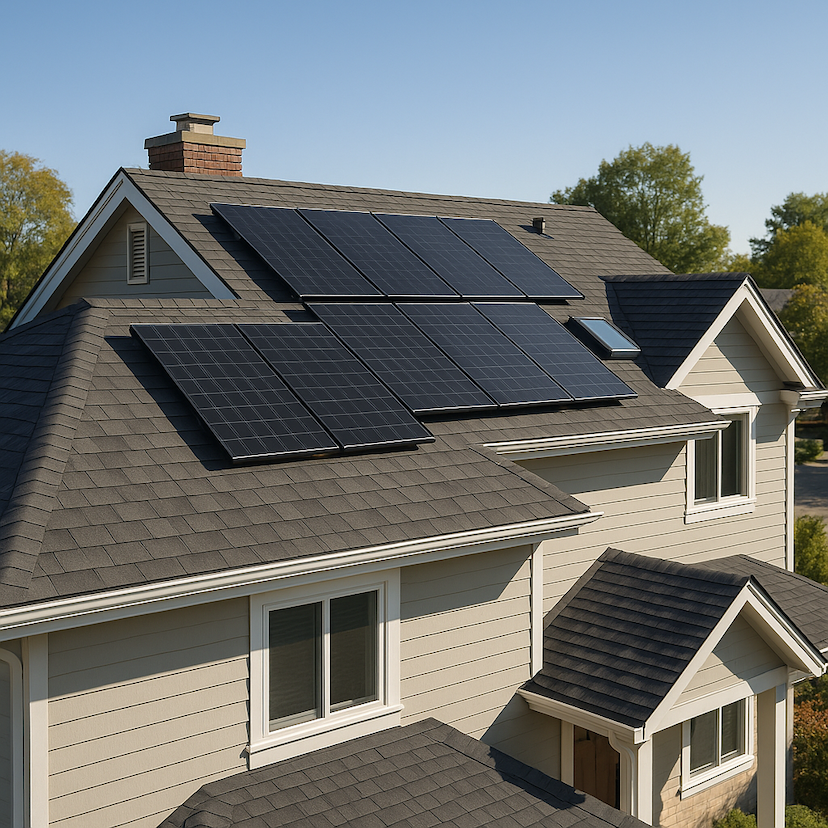
The NEC 690 125% rule is the backbone of safe PV source circuit sizing. Apply it correctly and you will right-size conductors and overcurrent devices, pass inspection faster, and avoid nuisance trips. Below you will find the exact calculations, practical examples, wiring methods under NEC 690.31, and related requirements inspectors check on every job. For a checklist of common AHJ expectations, see
Solar site inspections (what AHJs look for).
Size PV source circuits with the 125% rule
The 125% rule in NEC Article 690 tells you how to compute maximum PV circuit current and then choose conductors and OCPDs that can continuously carry that current without overheating.
Where the 125% comes from
Two multipliers often apply in PV design:
- PV current calculation - NEC 690.8 defines maximum circuit current based on module Isc and the number of parallel strings. Many jurisdictions still expect Isc to be increased by 125% for maximum current.
- Continuous current sizing - NEC requires conductors and OCPDs serving continuous loads to be sized at 125% of that current.
When both are applied, the net result is commonly treated as 156% of module Isc per string count. Always confirm with your adopted NEC edition and your AHJ. For how module performance influences sizing decisions, see
Understanding solar panel efficiency.
Step-by-step example
Assume a string uses modules with Isc = 9.5 A and you have 3 parallel strings.
- Sum Isc for parallel strings: 9.5 A x 3 = 28.5 A
- Apply 125% for maximum PV current: 28.5 A x 1.25 = 35.6 A
- Size for continuous current at 125%: 35.6 A x 1.25 = 44.5 A (the well known 156% overall multiplier)
- Select OCPD: Choose the next standard OCPD rating not less than 44.5 A, typically 45 A or 50 A per available standard sizes and listing.
- Choose conductor ampacity: Conductor ampacity after all derates must be at least 44.5 A.
Apply additional derating after the 125% continuous factor, such as temperature correction and conduit fill, so the final adjusted ampacity remains at or above the required value. If you're budgeting an on-site assessment to verify measurements and conditions, review
Cost of a solar site visit.
Picking OCPDs and conductors the right way
- OCPD rating - Not less than 125% of calculated PV current. Use a listed, PV-rated fuse or circuit breaker with appropriate DC voltage rating.
- Conductor ampacity - After temperature, rooftop, and fill adjustments, the resulting ampacity must still be at least 125% of calculated PV current.
- Terminations - Respect 60 C or 75 C terminal limits per equipment labeling when selecting wire ampacity from the appropriate 60 C or 75 C column.
Voltage and temperature corrections under NEC 690.7
Cold weather increases PV voltage. NEC 690.7 requires you to calculate maximum system voltage at the lowest expected temperature to ensure equipment voltage ratings are not exceeded.
- Start with module Voc at STC
- Apply the temperature correction factor from the module datasheet or NEC tables for the minimum site temperature
- Multiply by modules in series to get maximum string voltage
Example: A module with Voc 40.0 V at 25 C, temperature coefficient of -0.30% per C, and a site low of -10 C. Delta T is -35 C. Voltage increase is 0.30% x 35 = 10.5%. Corrected module Voc is 44.2 V. For 12 modules in series, max string Voc is 530.4 V. Select inverters, combiners, and DC disconnects with voltage ratings above this value and within NEC 690 limits for your system type.
Overcurrent protection you must include
PV source and output circuits need overcurrent protection sized at not less than 125% of the calculated current. Use listed PV fuses or DC-rated breakers. Protect each source circuit when parallel connections could allow backfeed into a faulted string. Coordinate OCPDs with conductor ampacity and equipment voltage ratings.
Disconnecting means and rapid shutdown essentials
Provide accessible DC and AC disconnects so responders and service technicians can isolate equipment. For rapid shutdown, NEC 690.12 requires reducing voltage to touch-safe levels within a specified time. Many jurisdictions adopting recent NEC editions require 30 V outside the array boundary within seconds and module-level control on rooftops. Verify details with your AHJ and equipment listings.
Grounding and bonding fundamentals
Bond all metallic racks and module frames with listed hardware and connect them to the equipment grounding conductor. Follow equipment instructions for grounding lugs, torque, and sequencing. Size grounding conductors per NEC in coordination with the largest OCPD on the DC side. Ensure continuity across rails and splices and keep terminations protected from corrosion.
Marking and labeling inspectors look for
- Module nameplate - Voc, Isc, Vmp, Imp, max system voltage
- PV power source labels - Operating current and voltage at disconnects and combiners
- Rapid shutdown labeling - Placards at service equipment indicating the rapid shutdown type and boundaries
- Raceway labels - Permanent, outdoor-durable PV circuit identification where required
Wiring methods under NEC 690.31
Wiring methods are one of the most inspected parts of a PV installation. Use conductors and wiring systems listed for the environment, temperature, and sunlight exposure, then route and secure them according to code and listings.
| Cable or wiring method |
Typical use |
Key attributes |
| PV Wire (Photovoltaic Wire) |
Exposed module-to-module and homeruns in arrays |
Sunlight resistant, wet-rated, typically 90 C or 105 C insulation, single-conductor |
| USE-2 |
Exposed array conductors in some cases |
Sunlight resistant, wet-rated, single-conductor. Check limits for transitions into buildings |
| MC Cable (Metal-Clad) |
Inside buildings or protected runs |
Factory assembly with metal sheath, supports 600 V or 1000 V ratings per listing |
| TC-ER |
Cable tray or certain rooftop runs where allowed |
Exposed run permitted where listed TC-ER, sunlight resistant, must be supported per code |
| Raceways (EMT, RMC, PVC where permitted) |
Transitions into buildings and protected routing |
Protects conductors like THWN-2. Use proper fittings, expansion where required, and support spacing |
- Temperature ratings - Use 90 C wet-rated insulation where exposed to high rooftop temperatures. Apply rooftop temperature adder where required before ampacity corrections.
- Sunlight and wet locations - Select cables listed as sunlight resistant and wet-rated when exposed outdoors.
- Routing and protection - Keep conductors supported, protected from abrasion, and out of water paths. Use raceways for penetrations into buildings and transition to building wiring methods at the point of entry.
- Securing and support - Follow listing instructions and code for strap intervals and attachment methods. Keep conductors under modules neat, elevated off roofs where required, and protected at edges.
- Small-gauge leads - 16 AWG and 18 AWG are allowed when part of listed assemblies and within equipment ratings. Do not extend them beyond their intended use.
- Identification - Mark DC PV raceways and enclosures as required with permanent, UV-stable labels at the specified intervals.
Batteries and energy storage interfaces
When PV connects to storage, follow NEC 690 plus the applicable energy storage article adopted in your edition. Newer codes reference Article 706 for Energy Storage Systems, while older editions use Article 480. Key points include dedicated disconnects, proper OCPD sizing on both DC and AC sides, ventilation or thermal management per the battery type, and clear labeling of ESS boundaries and shutdown procedures. Keep conductors short and protected, respect manufacturer temperature limits, and verify communication and control wiring routing to avoid EMI with power conductors.
FAQs
What is the 125 rule in the NEC?
It is the continuous load sizing rule. For loads expected to run for 3 hours or more, the NEC requires conductors and OCPDs to be sized at not less than 125% of the load current. In PV, this pairs with PV-specific current calculations in NEC 690.
What is the 125 percent rule for solar panels?
PV circuit current is calculated from module Isc and stringing, often multiplied by 125%. Then conductors and OCPDs are sized at 125% of that value. Many designers treat this as 156% of Isc for source circuits. Confirm details with your adopted code edition and AHJ.
What is the 120% solar rule NEC?
It governs how much PV current you can backfeed into a panelboard busbar. In many editions, total of the main breaker plus PV breaker cannot exceed 120% of the bus rating, and the PV breaker must be at the opposite end from the main. Example: 200 A bus with 200 A main allows a 40 A PV breaker. See NEC 705 for your edition.
What is Article 690 of the NEC?
Article 690 covers solar photovoltaic systems. It defines PV-specific circuit calculations, wiring methods, overcurrent protection, grounding and bonding, disconnects, marking, and rapid shutdown requirements.
If you want to educate prospects about code basics while you design faster, Enervio’s AI-driven platform can deliver state-specific guidance and help you generate proposals in minutes without site visits.